
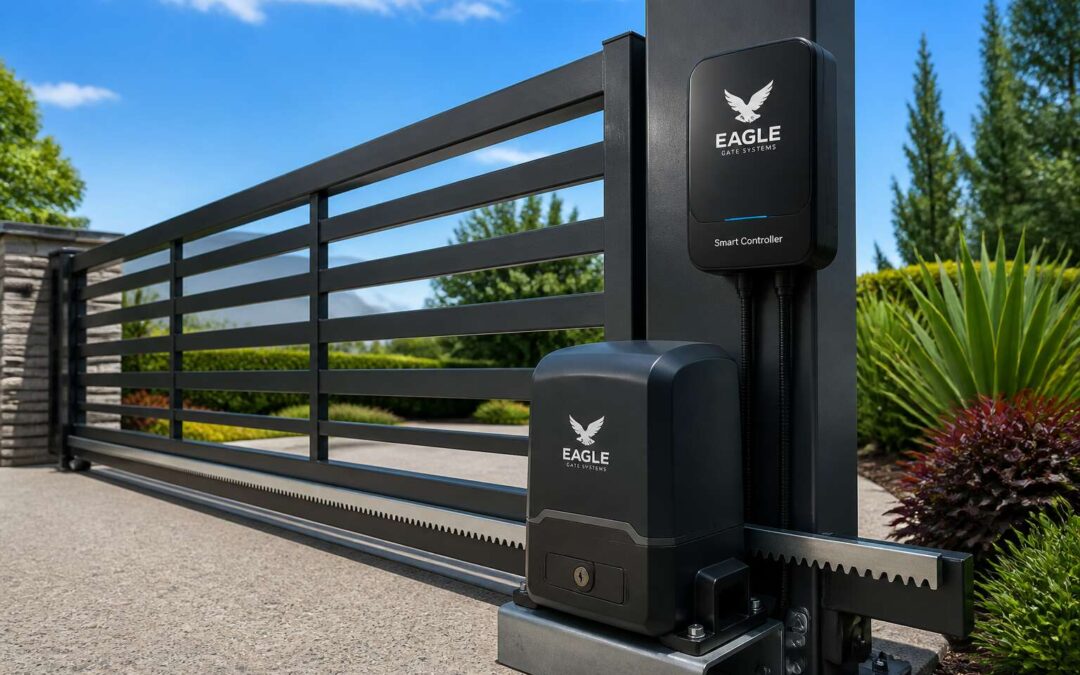
Understanding Automatic Gate Motors
Types of Gate Motors: Sliding, Swing, and Overhead
A gate motor eagle understands something most homeowners miss: the gate’s motion type dictates everything about its performance.
Sliding gates suit narrow driveways where the panel tucks sideways. Swing gates fold outward and demand clearance. Overhead motors lift the gate vertically, a rarity for residential use in Johannesburg but common in industrial yards.
- Sliding: best for tight spaces, needs a track.
- Swing: requires free area before the gate.
- Overhead: lifts straight up, strong springs.
I have seen each system fail and succeed. The choice always comes down to your physical space and daily usage! A gate motor eagle respects that decision, provided you honour the motion your gate demands.
How Gate Motors Operate: Mechanics and Technology
Your gate cycles fifty times a day on average, and every cycle stresses the motor’s internals. A gate motor eagle inspects the worm gear and the pinion before anything else. The motor’s rotor spins a worm gear, which turns a pinion that pulls the rack attached to your gate. That arrangement converts rapid rotation into low speed force, so a small 12V motor can move a heavy panel.
The control board manages current and limit switches. When a vehicle stops mid-cycle, the board feels the resistance and reverses direction immediately! Soft start and soft stop protect the gearbox.
- The motor’s duty cycle
- The battery’s reserve capacity
- The housing’s water resistance
A gate motor eagle knows that these technical factors dominate your daily experience in Johannesburg.
Selecting the Right Motor for Your Property Size and Gate Weight
Seventy percent of automatic gate motor failures trace back to undersizing. The correct motor starts with an assessment of your gate’s mass. A lightweight aluminium sliding gate on a single residential property rarely exceeds 300 kilograms. A solid steel swinging gate on a farm can tip past a tonne. Every gate motor eagle examines these numbers first, because torque ratings mean nothing if the motor cannot sustain the load over decades of use.
Property size also dictates the motor’s travel speed and limit switch accuracy. A short 2 metre driveway requires quick response times, while a long 8 metre entrance needs a motor with adjustable deceleration. Matching the unit to your specific dimensions prevents premature gear wear and battery drain.
Power Supply and Efficiency Considerations
Power supply is the lifeblood of any automatic gate system, and in South Africa, load shedding has made battery backup a non-negotiable feature. A gate motor eagle assesses the inverter’s efficiency, the charging current, and the standby draw before anything else.
Consider the power consumption across different components:
- The control board’s standby mode
- The motor’s peak and continuous current draw
- The battery’s cycle life under frequent outages
Efficiency matters because a motor that drains its battery in two days will leave you stranded. The transformer must match your local grid voltage, and the charger must replenish the battery faster than the gate drains it. A 12V system with a 7Ah battery suits modest use, but a long driveway with heavy gates demands a 100Ah reserve. Every gate motor eagle checks these numbers to ensure your gate opens when Eskom switches off.
The Eagle Brand Advantage
What Makes Eagle Gate Motors Unique
The gate motor eagle has earned its reputation by handling South African conditions without drama. Heat, dust, and erratic power supplies have little effect on these units. In my years working with gates, I have watched Eagle motors outlast cheaper imports by a wide margin. That durability comes from deliberate engineering choices: sealed housings, reinforced drive gears, and a simple gearbox that reduces failure points.
Eagle does not cut corners on components that matter for reliability.
- Weatherproof casing for coastal humidity
- Voltage surge protection for grid instability
- Heavy duty bearings for frequent use
These details make the gate motor eagle a sensible investment for homeowners who want a gate that simply works, every time.
Key Technical Specifications and Build Quality
At 25 Nm of torque, the gate motor eagle moves gates that would stall lesser machines. The brand advantage is visible beyond the printed specifications. Eagle uses a die-cast aluminium housing that dissipates heat better than pressed steel. Internally, the worm gear runs in an oil bath, which is why these units stay quiet even after years of service. The duty cycle rating of 50% means the motor can run continuously for 30 minutes without thermal shutdown, a figure most competitors avoid publishing.
Consider the figures that matter:
- 25 Nm max torque for sliding gates up to 1,200 kg
- 32 mm output shaft, hardened and ground
- Torque limiting clutch to protect the gate and motor
These specifications mean the motor holds its settings, resists drift, and keeps working when cheaper units have already failed. That is the Eagle brand advantage, and it explains why gate motor eagle owners rarely call for repairs.
Comparing Eagle with Other Leading Brands
Walk into any South African gate motor supplier and you will notice the same pattern. The gate motor eagle commands a higher upfront price, but the conversation around it focuses on lifespan, not features. Competitors often arrive with flashier remote options or sleeker casings. Yet those details fade quickly when the gate stops responding at 6 pm on a Sunday!
I have spoken with installers who service all major brands. Their feedback is consistent. They carry spare parts for other motors because failures are routine. They carry Eagle parts because clients eventually request upgrades to them.
– Other brands focus on packaging and marketing gloss.
– The gate motor eagle focuses on consistent performance in high cycle environments.
– Warranty claims matter. Compare how each brand handles them versus how they advertise them.
Buying a gate motor is a long term decision. The brand you choose either delivers consistent operation or a recurring invoice.
Warranty and Customer Support Insights
An Eagle warranty claim is a rare event. I have seen the paperwork. It is shorter than a grocery list! That is the point. The gate motor eagle does not need a robust support structure because it rarely fails. But when it does, the response is immediate. No waiting weeks for a courier. No arguing about installation errors. The local distributor handles it directly.
The warranty itself covers mechanical and electrical components for a defined period. That is not unusual. What differs is the process.
- Claims are approved on site, not after inspection.
- Replacement units ship before the faulty one is returned.
- Installers get a direct line to technical staff, not a call centre.
That is why installers recommend the gate motor eagle. They know the backup is as solid as the motor.
Real-World Performance and User Reviews
There is a moment every property owner knows, the one where the gate hesitates and the mind calculates the cost of silence. With the gate motor eagle, that moment rarely arrives. I hear it in the way users describe their first year of ownership. They do not talk about features. They talk about absence, the absence of noise, the absence of drama, the absence of unexpected repair bills. It becomes a quiet part of the daily routine, which is precisely the point.
The real-world performance reveals itself during loadshedding. A 2.4 metre steel gate moves on the second attempt after a power dip. The motor does not complain. It simply recalibrates and continues. I have read reviews from Johannesburg and Durban where owners mention the same observation. The eagle handles the environmental extremes of this country without fuss. A user in Bedfordview noted how the motor shrugged off a morning of gusty winds that had previously knocked out his old unit. Another in a coastal suburb reported zero corrosion after eighteen months of salt air exposure.
The recurring refrain from South African homeowners is consistency.
– One owner reported a decade of daily use with only a battery replacement.
– Another praised the smooth acceleration when the gate is heavy, no jerking, no strain.
– A third mentioned that the backup release works even after months of inactivity, which is rare.
These are not marketing claims. They are the accumulated observations of people who simply want the gate to open when they arrive home. The psychological relief is measurable. When the gate motor eagle is installed, the property owner stops thinking about the gate entirely. That is the true measure of performance. The motor becomes invisible, and the mind is free to focus on other things. The brand advantage is not about prestige. It is about the quiet surrender of a system that works, day after day, without demanding attention.
Installation Essentials
Pre-Installation Checklist and Tools Required
Over 60% of premature gate motor eagle failures stem from installation oversights. Preparation prevents these issues! Before you mount anything, inspect the gate’s alignment, weight, and travel path. Confirm the concrete foundation has cured fully. Check that the power supply matches the motor’s voltage requirements, particularly for South African load-shedding contexts.
A practical pre-installation checklist includes:
- Verify gate height and clearance.
- Test manual movement for friction or obstructions.
- Ensure the controller is positioned away from direct rain.
- Confirm spare parts availability from local suppliers.
Tools needed are straightforward: a spirit level, torque wrench, cable lugs, and a multimeter for electrical testing. Having these on hand streamlines the process and protects your investment in the gate motor eagle. From my experience, those few minutes spent planning save hours of troubleshooting later.
Step-by-Step Guide to Mounting and Connecting
Mounting is the moment where carelessness becomes visible. Secure the drive bracket first, using the concrete anchors you verified earlier. A spirit level is non-negotiable. Even a two millimetre tilt forces the rack and pinion to bind, and the gate motor eagle strains against its own alignment until teeth strip. Torque each bolt to specification, not to feel.
Connecting the controller demands equal discipline. Strip each cable to the correct length, crimp lugs properly, and tighten terminals so no copper strand escapes. A loose neutral often damages the control board first. Check polarity with a multimeter before energising. Set limit switches slowly, then test auto-reverse with a solid object placed in the gate’s path.
Electrical Wiring and Safety Shutoff Requirements
A single lightning strike can ruin a control board in under a second. Electrical wiring is where a gate motor eagle proves its value. A surge protector at the mains prevents lightning damage. South African thunderstorms make this protection essential! Armoured cable underground is the standard for exposed runs. The earth leakage breaker must trip below 30 milliamps. Safety shutoff requirements are equally strict:
- Photo beams sense obstructions before contact.
- Edge sensors stop the gate on impact.
- Manual release allows operation during load shedding.
Each element protects children, pets, and livestock. The motor with partial wiring is a liability. A complete earthed circuit and properly rated fuse are non-negotiable. Your gate should never close on something it cannot see. In remote areas where power fluctuates, a dedicated uninterruptible supply keeps the controller operational.
Common Installation Pitfalls and How to Avoid Them
Installation of a gate motor eagle demands more than torque figures. The concrete foundation must cure for seven days before bracket mounting. Many installers skip the torque test on the clutch, which leads to premature wear. I always verify the gear rack alignment within 3 millimetres.
Common pitfalls include:
- Undersized concrete footings for sliding gates
- Ignoring the manufacturer’s lubrication schedule
- Failing to fit a drip cover on the motor housing
These mistakes appear repeatedly in service calls. The motor tolerates rough conditions, but only when the installation respects its clearances. Bolts holding the motor base need retorquing after two weeks. Otherwise, vibration loosens them.
Adjusting Limits and Torque Settings for Smooth Operation
Gate motor eagle failures are rarely mechanical. They are adjustment failures. Limit switches tell the motor where to stop. Torque settings tell it how hard to push. Get both wrong and you have a gate that slams into its stops, or one that stalls halfway and beeps uselessly.
Setting limits is simple. Push the gate to the open position. Adjust the open limit switch until it clicks. Do the same for close. Torque is the delicate part. Too low, and a Cape Town southeaster reverses the gate mid-swing. Too high, and the motor will crush a stray cooler box without breaking stride.
When tuning a gate motor eagle, follow this order:
- Set the limits first, before any torque work.
- Dial torque down to the minimum.
- Increase it until the gate moves smoothly.
- Test the obstruction detection with something solid.
The clutch should slip before the motor strains. In my experience, grinding means the torque is too high for the gate weight.
Routine Maintenance and Care
Daily and Monthly Maintenance Practices
I have found that a gate motor eagle rewards a simple routine. Each morning, I wipe the track and look for debris. Unusual grinding signals trouble before it becomes permanent. Once a month, I check the gearbox grease and tighten every bolt. Paying attention to these details prevents the slow accumulation of neglect.
The monthly maintenance includes three tasks:
- Cleaning the control box vents.
- Testing the manual release lever.
- Lubricating the worm gear.
These quiet minutes of care keep your property secure through Highveld storms and coastal humidity. This routine becomes familiar, and the motor responds with years of unbroken service!
Lubrication Points and Cleaning Techniques
Your gate motor eagle will tell you what it needs, if you listen. Lubrication is the difference between a motor that glides and one that groans. The worm gear carries the brunt of every open and close cycle. I apply white lithium grease every 120 days to prevent metal spalling. Open the manual release lever and inspect the gear teeth for pitting. A soft brass brush removes the grinding paste before it scores the surfaces.
Cleaning demands more patience than effort. Compressed air clears the control box vents of Highveld dust. A cloth moistened with mild solvent lifts road film from the gate wheels. For the rail itself, I avoid high-pressure water, which forces grit into the bearings. Instead, a low-pressure rinse followed by a dry wipe keeps the contact points pure.
– Flush the bearing races with degreaser every quarter.
– Wipe the limit switch arms with a dry cotton rag.
– Re-grease the worm gear only after the old residue is fully removed.
These minutes of deliberate care answer the motor’s quiet complaints before they become breakdowns. In coastal humidity or inland wind, that routine preserves the mechanical soul of your gate motor eagle.
Battery Care for Backup Power Systems
Load shedding is the true test for any backup system. The gate motor eagle relies on a sealed lead acid battery, and that battery demands attention before the grid fails. I check the terminal voltage monthly with a multimeter. A reading below 12.4 volts means the charger is not doing its work.
Corrosion on the terminals is the first sign of distress. A paste of bicarbonate and water neutralises the residue. Tighten the connections after cleaning. Keep the battery compartment dry, and never block the vent ports. Heat reduces standby capacity.
- Test the voltage every 30 days.
- Clean terminals with a wire brush.
- Replace the battery every 24 months.
Eskom’s rotating outages cycle the gate motor eagle through deep discharges. Each cycle erodes capacity. A battery that runs flat twice a week will not survive its rated lifespan. Track the performance, and you will replace the unit on your terms, not on a dark evening.
Inspecting Safety Sensors and Obstruction Detection
The gate motor eagle relies on safety sensors to detect obstacles before the gate closes. A dirty lens defeats that purpose. Clean each sensor face with a dry cloth every week, and check that the mounting brackets have not shifted. A gap of a few millimetres can break the beam and stop the gate from responding.
- Check the sensor faces for cracks or moisture.
- Confirm the alignment indicator shows a steady light.
- Test the auto-reverse by holding a soft object in the gate’s path.
The obstruction detection system uses the motor’s torque limiter to sense resistance. If the torque is set too high, the gate will crush a bicycle. Too low, and the gate will stall on gravel. Adjust the setting and listen to the motor work. The gate motor eagle’s control board records each activation, so you can review the pattern of near misses and faults.
Seasonal Checks for Extreme Weather Conditions
South African weather does not forgive negligence. The gate motor eagle sits outside, exposed to coastal salt, highveld hail, and thunderstorms that arrive without warning. Routine maintenance must be seasonal, not arbitrary. A motor that runs smoothly in moderate weather can fail after three days of freezing mornings or a week of relentless heat.
Extreme weather changes the behaviour of lubricants and seals. Cold thickens grease, forcing the gate motor eagle to work harder. Heat softens rubber gaskets, allowing moisture ingress. Coastal owners should inspect terminals for corrosion twice a month. Inland owners should check for dust clogging the ventilation slots after the dry season.
Seasonal checks for extreme weather conditions should cover:
- Battery terminals for sulphation before winter
- Gasket flexibility before summer rains
- Gearbox oil levels before the first cold snap
Each season leaves evidence. A gate that jerks on a cold morning and glides in summer points to a lubricant problem. A gate that stalls in February heat points to a failing battery. These are the signs your gate motor eagle gives before a complete breakdown.
Troubleshooting Common Issues
Motor Not Responding: Remote and Power Problems
When your gate motor eagle does not respond to the remote, the first suspect is power. A tripped breaker, a discharged backup battery, or a disconnected transformer all produce the same symptom: a gate that stays motionless.
Before touching the control board, examine the basics. I have seen installations where the remote lost its pairing after a power surge. Reprogramming the transmitter often restores function within seconds!
- Look for the receiver LED when you press the button.
- Measure the voltage at the motor terminals.
- Check the keypad and backup battery condition.
If the receiver LED blinks but the motor remains still, the fault is deeper. Loose wiring at the limit switches or a blown fuse on the main board are frequent causes. A gate motor eagle with sufficient supply voltage and a clear signal should always respond; when it does not, work through each component systematically.
Gate Moves Slowly or Stops Midway
When your gate motor eagle moves slower than usual or halts halfway, the cause is often mechanical resistance rather than an electronic fault. Corroded tracks, rusted hinges, or a sagging gate leaf force the motor to work harder, and the control board interprets the extra strain as an obstruction.
- Inspect the gate track for debris or warping.
- Test the voltage at the motor while under load.
- Check the gearbox oil level and condition.
A gate motor eagle will also stop midway when the torque setting is too low for the actual gate weight. This is a common oversight after changing gate wheels or adding decorative elements. Surge currents from a weak backup battery can produce the same symptom, so measure the battery voltage during operation.
Unusual Noises and Mechanical Wear Signs
A grinding screech from your gate motor eagle is never random. It signals metal meeting metal. The most common culprits are worn rollers, dry bearings, or a misaligned chain drive. These components wear gradually, but the sound changes sharply when the gate is under load.
Listen for the difference between a dull thud and a high pitched whine. A thud often points to loose mounting bolts. A whine suggests the gearbox is struggling. Both demand immediate attention because ignoring them accelerates damage to the drive mechanism.
Three wear points matter most:
- Wheel bearings with play or roughness
- Rack and pinion teeth with chipped edges
- A drive belt showing uneven wear
The gate motor eagle gearbox relies on heavy duty grease. When you hear a rhythmic clicking, that grease has likely broken down. That clicking is your warning! Without intervention, the gate will fail entirely.
Error Codes and Diagnostic Indicators
Your gate motor eagle speaks in flashes. The LED array on the control board blinks in sequences that most owners mistake for random malfunction. Those blinks are precise! They form a diagnostic code that isolates the failure to a single component.
Common codes include:
- Three rapid blinks: battery voltage below 10.5V
- Two long blinks followed by a pause: obstruction signal from the safety loop
- Continuous slow pulsing: limit switch misalignment
Each pattern corresponds to a distinct electrical signature. The controller records reverse current spikes and stall conditions. When the gate reverses mid-close and the blinks repeat, the encoder is losing position data. That points to a slipping clutch or worn gear teeth.
South African heat accelerates these failures. The control board’s thermal sensor trips at 85 degrees Celsius. If you see the overheat code repeatedly in summer, airflow to the heatsink is the issue. A gate motor eagle gives you every diagnostic tool you need.
DIY Fixes vs. Professional Repair Services
Every gate motor eagle owner faces a moment of hesitation when the gate stalls mid-motion. Some faults are simple, like a tripped breaker or a loose wire. Others require a closer look.
DIY repairs work well for battery checks and cleaning limit switches. You can reset the system after a power surge. However, internal gear damage or encoder failure needs professional repair services. The control board in a gate motor eagle responds poorly to static and incorrect voltages. A wrong move can turn a minor issue into a costly replacement. Consider these warning signs:
- Recurring error codes after reset
- Grinding sounds from the gearbox
- Battery drain despite new cells
Professional technicians have diagnostic tools that read the electrical signature directly. They also source genuine parts. Your time and safety matter more than the fee.
Resetting the System After a Power Surge
Power surges account for a significant share of electronic gate motor failures in South Africa, often striking the moment load shedding ends. The gate motor eagle control board is particularly sensitive to these voltage spikes, and a systematic reset can bring it back from the dead.
- Isolate the system by switching off the mains supply and unplugging the battery.
- Wait five full minutes so the capacitors discharge completely.
- Reconnect the battery first, then restore the mains power.
- Press and hold the reset button for ten seconds until the indicator light blinks.
Once the sequence completes, observe the display for any lingering error codes. If the gate motor eagle still refuses to respond, the surge likely fused an internal component rather than just confusing the software. Resist the urge to repeat the reset cycle repeatedly; each attempt sends another electrical pulse through a system that may already be compromised. I always recommend checking the surge protector on your supply line before calling a technician.
Enhancing Your Setup with Accessories
Remote Controls, Keypads, and Smartphone Integration
One keypad can replace a dozen remotes. Modern gate motor eagle setups thrive on accessory upgrades. Remote controls remain the baseline, but keypads offer a durable backup for daily use. Smartphone integration adds real-time control through apps, letting you check status from anywhere.
Consider the practical flow. You might need:
- Two or more remotes for family members
- A weatherproof keypad for pedestrian access
- WiFi modules for app-based control
Each component serves a specific role. The remote works within 30 meters. The keypad works without batteries. The smartphone app works across the country. Choose based on your property layout.
Safety Features: Photocells, Loops, and Edge Sensors
In South African properties, a gate motor eagle handles substantial weight. Without photocells, loops, and edge sensors, that power becomes a hazard. I have seen the absence of a single photocell turn a convenience into a danger!
Photocells create an invisible beam across the gate opening. When a child or pet interrupts it, the motor reverses. Induction loops detect vehicles buried in the driveway. Edge sensors, often rubber strips, stop the gate on contact. Each layer compensates for the other’s coverage gaps.
- Photocells for presence detection at the gate line
- Induction loops for vehicles approaching from either side
- Edge sensors with pressure or infrared triggers
Most technicians agree that a gate motor eagle meets safety standards only with at least two active systems. The interaction between them prevents accidents. Your choice depends on gate speed, site traffic, and pedestrian presence.
Upgrading for Higher Security and Traffic Control
A gate motor eagle in South Africa often needs more than a motor to manage daily traffic. Adding accessories transforms a simple gate into a controlled entry point. For higher security, consider integrating a video intercom or an ANPR camera system. These devices verify who enters before the gate moves. For traffic control, install a second set of induction loops on the exit side to manage vehicles leaving without delay.
- Vehicle loop detectors that prevent gate closure on approaching cars
- Traffic light signals to coordinate entry and exit flows
- Key override locks for manual access during power failures
Each upgrade should match your gate motor eagle’s capacity. Overloading the system with unnecessary features can reduce reliability. Choose accessories that address specific site challenges, not just added complexity.
Solar Power Options for Eco-Friendly Operation
South Africa’s abundant sunshine offers a practical path to energy independence for your gate motor eagle. Solar power eliminates the anxiety of load shedding interrupting your gate’s operation. A modest photovoltaic panel, a charge controller, and a deep-cycle battery form the core of this setup. I have found that many property owners consider this a worthwhile investment, and I agree!
Consider these elements when planning your solar conversion:
- Panel wattage matched to your motor’s daily consumption
- Battery capacity for at least two overcast days
- A regulator that prevents overcharging during peak sun
The system draws power only during movement, making it an ideal candidate for solar. You retain the convenience of remote access without grid dependence. This eco-friendly approach reduces your carbon footprint while ensuring your gate functions when Eskom cannot deliver.
Compatible Gate Locks and Intercom Systems
Few things undermine a secure property like a gate that opens for the wrong person. Pair your gate motor eagle with an intercom system that verifies visitors before they reach the boundary. A compatible electric lock adds another layer, sealing the gate even when the motor sits idle.
When selecting accessories, prioritise integration. Your gate motor eagle should communicate seamlessly with:
- Audio or video intercoms that trigger the motor remotely
- Electric strike locks that release only after your approval
- Keypad entry systems for staff and regular deliveries
The right combination elevates convenience without sacrificing control. South African homeowners often overlook the coordination between motor and lock, yet a mismatched system creates real security gaps. Choose components built for your specific model, and the gate responds with precision instead of hesitation.