
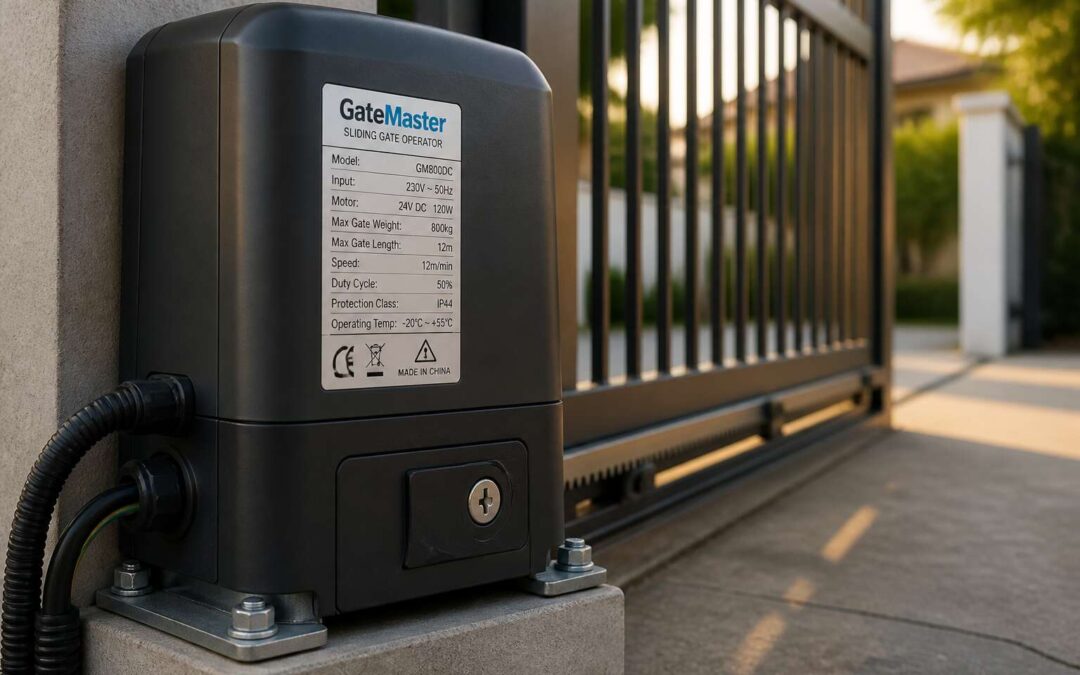
Understanding Gate Motor Power Consumption
What Are Watts in the Context of Gate Motors
For most South African households, the gate motor is an afterthought until the battery dies during a blackout. The gate motor watts determine how long that backup power lasts, yet few owners ever check the specification. Watts measure instantaneous power draw, distinct from the total energy consumed over time.
Consider the motor resting at your boundary wall. It idles in standby for hours, then surges to full output when a vehicle approaches. This cycle repeats across every estate, and those gate motor watts accumulate into a real portion of your daily electricity demand.
Typical residential figures:
- Standby: 5 to 10 watts
- Active operation: 250 to 350 watts
- Peak surge: 400 to 500 watts
A 150-watt difference between motor models feels abstract on paper. During stage four loadshedding, on inverter power, that difference becomes a trade-off between opening the gate and keeping the fridge cold.
Why Wattage Matters for Gate Operation
Neighbours with identical houses can face opposite outcomes during loadshedding, simply because one motor has a higher power draw at start-up. That is why reading the spec sheet matters more than the price tag.
Wattage affects operational reality. A motor that draws heavily will drain a battery faster, and a weaker battery means fewer gate cycles before recharge. For homes on solar or inverter systems, this directly changes how long essential appliances keep running!
- Start-up surge determines inverter sizing
- Standby draw affects continuous battery drain
- Cycle frequency multiplies daily energy use
When you understand these gate motor watts, you begin to see the motor as part of your energy budget, rather than a mechanical convenience.
Peak Watts Versus Rated Watts
Peak watts are the motor’s dramatic entrance. Rated watts are its daily grind. A gate motor that claims 500 watts on the box might only need 80 to keep moving, but that 500 appears the moment it jolts awake. This distinction matters because your inverter sees both numbers. The peak determines the surge capacity you must buy. The rated determines how long your battery survives. In South Africa, where loadshedding turns driveways into parking lots, confusing these two figures is a costly mistake. Understanding gate motor watts means respecting both. Consider the numbers:
- Peak watts: the brief, hungry burst at start-up.
- Rated watts: the steady, modest draw during operation.
Most spec sheets list both, but the peak is what trips your system. Ignore it and your gate becomes a paperweight.
Factors That Influence Gate Motor Wattage Requirements
Gate Weight and Physical Size
The true wattage a gate motor draws is dictated by physics, not guesswork. The most significant factor is the physical mass of the gate itself, as every kilogram must be moved from a dead stop. A lightweight tubular aluminium gate offers far less resistance to a motor than a solid steel security gate designed for high-density suburbs. You must calculate the weight of the material, including the added heft of slats or cladding. Attempting to move a heavy structure with a motor rated for a lighter one forces the system to operate in a constant state of strain, burning excessive gate motor watts and leading to premature wear.
Beyond sheer mass, the engineering of the installation determines the workload. Friction is the silent adversary here. Consider these elements that compound the raw weight:
– The condition and alignment of the gate wheels and track.
– The angle of the driveway; an incline demands significantly more torque.
– Wind load, which is substantial for solid panel gates in open areas.
– Corrosion or rust on hinges that increases rolling resistance.
Each of these variables adds to the baseline requirement, meaning a gate weighing 300 kilograms might demand the same power as a 400-kilogram gate fitted with poor wheels. Consequently, the wattage requirement is not a fixed number but a calculation of total system resistance. Ignoring these factors leads to an underpowered unit that struggles and stalls, whereas a properly specified motor runs with smooth efficiency, preserving the longevity of the entire mechanism.
Frequency of Daily Use
Every cycle of a gate motor is a burst of effort demanding power beyond the steady rating. Frequency of daily use transforms that burst into cumulative strain. A suburban Johannesburg home might run its gate thirty times per day, while a shared security complex can exceed a hundred. This frequency directly determines the true need for gate motor watts.
Repeated startups generate heat, which lowers efficiency and increases internal resistance. A motor that runs every ten minutes must cope with thermal buildup, so its rated capacity needs a buffer. A weekend cottage gate, opening only a handful of times, allows the system to cool between runs.
Common frequency profiles include:
1. Light use: under ten cycles daily.
2. Moderate use: twenty to forty cycles.
3. Heavy use: over sixty cycles, requiring a larger wattage margin.
For heavy cycles, gate motor watts must be specified with the duty cycle in mind, otherwise the unit overheats and trips its thermal protection.
Duty Cycle and Operating Conditions
Duty cycle and operating conditions often decide whether a motor survives its first year. Gate motor watts represent only part of the equation. Duty cycle measures the ratio of running time to resting time. A motor that operates for two minutes and rests for eight has a different thermal profile than one that runs continuously. The duty cycle percentage determines how much heat the windings must shed. In South Africa, summer temperatures frequently exceed thirty degrees, which reduces a motor’s ability to cool itself. Coastal salt air and inland dust infiltrate bearings and windings.
Operating conditions stack onto the duty cycle. Consider:
– Ambient temperature above 35 degrees Celsius
– High humidity or coastal corrosion
– Wind loading on the gate panels
– Voltage fluctuations common in older suburbs
Each factor lowers the effective rating of any given motor. Selecting gate motor watts without adjusting for these variables means the unit operates closer to its thermal limit than the datasheet suggests.
Supply Voltage and Motor Type
South Africa’s grid delivers a nominal 230 volts, yet many suburbs experience dips during peak hours. These dips matter because a motor’s wattage rating assumes a steady voltage. When voltage sags, the motor compensates by drawing more current, which inflates the actual gate motor watts consumed. The unit runs hotter and labours harder than its nameplate suggests. I have watched this effect shorten motor life more than any other single factor.
Motor type compounds the issue. AC induction motors, common in older installations, deliver robust torque but draw heavily at startup. Modern DC motors convert battery power through an inverter and operate with greater efficiency. The distinction shapes the gate motor watts you must plan for. A DC unit may require fewer running watts, while an AC unit needs a more generous sustained supply. Choose accordingly, because the supply voltage in your area determines how much headroom you truly need!
How to Calculate the Right Wattage for Your Gate
Step-by-Step Wattage Calculation Method
Calculating the right gate motor watts should not involve guesswork. In fact, the most common cause of motor failure in South African homes is an undersized unit that draws too much current from the wrong calculation. The method I use takes about five minutes with nothing more than a tape measure and a kitchen scale.
- Weigh the gate panel completely, including hinges and wheels attached.
- Multiply that mass in kilograms by 0.3 for nylon rollers, or 0.5 for steel wheels.
- Divide the result by the time in seconds you want the gate to open fully.
- Add 25 percent to cover gearbox friction and cable resistance.
That final figure is the minimum mechanical power needed at the drive shaft. To convert that into electrical demand, divide by 0.8 for efficiency losses. The number you land on becomes your reference point when comparing gate motor watts across different brands. If your calculated value sits near a rated peak limit, move one size up, because altitude and heat derate the motor’s output in practice.
Measuring Gate Resistance and Friction
A gate that resists the pull of a spring scale at nine in the morning will stop a motor dead by two in the afternoon. That is why measuring gate resistance matters more than any label on the box. I have watched installers hook a scale to the leading edge, pulling slowly to find the breakaway force before the gate moves.
The reading captures everything. Roller drag, hinge wear, the silent friction of a misaligned rack. The mass of the panel is only part of the story. Slope and wind add their own stubbornness. When you compare gate motor watts across brands, remember that those figures come from a clean test bench, not your driveway. The gate motor watts you need depend on what the scale tells you.
So measure the pull! Factor in the afternoon heat. That small effort prevents a motor that stalls halfway through the cycle.
Adding Safety Margins for Seasonal Changes
The scale read 82 newtons at nine in the morning. By two, the same gate demanded 110. That difference is your seasonal margin. Calculate the right wattage by multiplying your measured force by the gate speed in meters per second, then add 30 percent for heat expansion and wind.
- Metal gates expand in the afternoon sun, increasing roller drag.
- Dust and rain add temporary friction to hinges and tracks.
- Strong coastal winds push against the panel surface.
You want the gate motor watts to cover the worst day, not the best. A motor that barely succeeds in winter will stall in summer. A 40 percent reserve absorbs the gap between a clean test bench and real friction.
Typical Wattage Ranges for Residential and Commercial Gates
A gate that opens effortlessly in the morning can demand 34 percent more power by late afternoon. I have witnessed this scenario on installations from Randburg to Durbanville. Converting your friction measurement and speed calculation into gate motor watts is straightforward: multiply newtons by metres per second. That figure represents the continuous load. Your chosen motor’s rated output must exceed it, substantially.
Typical wattage ranges guide this process:
- Residential swing gates: 250 to 500 gate motor watts
- Residential sliding gates: 300 to 600 watts
- Commercial and industrial gates: 800 to 1500 watts
These bands reflect South African conditions. A 400 kilogram suburban swing gate fits within the lower half. A 900 kilogram farm sliding gate needs the top end. Matching measured resistance to one of these ranges prevents the guesswork that leads to premature motor failure.
Energy Efficiency and Operating Cost Considerations
AC vs DC Gate Motors and Their Power Profiles
AC motors draw substantial current every time they start, so their wattage peaks are brief but expensive. DC motors, by contrast, operate from a battery bank and only siphon energy from the grid during recharging cycles. This distinction changes how you calculate long-term running costs.
- AC motors use more gate motor watts per cycle because of high inrush current.
- DC systems convert and store energy, flattening the consumption curve.
In South Africa, where electricity tariffs climb yearly, the difference shows itself on your municipal bill. A 24V DC unit might draw 300W for ten seconds, while an AC equivalent demands 800W for the same movement. Over a year of daily use, those seconds accumulate into kilowatt-hours. The battery buffer also protects against load-shedding interruptions, which shifts the cost conversation from raw wattage to system resilience.
Standby Power Consumption Explained
Standby power consumption rarely appears on a gate motor specification sheet, yet it never stops drawing from your meter. Most gate motor watts are calculated while the gate moves, but the unit sits idle for 99% of its life. That idle state still costs money.
Consider the quiescent draw of a typical control board, radio receiver, and battery charger. These components sip anywhere from 5W to 15W continuously. For a 24V system, that is roughly 360Wh per day without a single opening. Multiply by 365 days and your annual standby expense becomes a real figure.
Common standby consumers include:
- The charger maintaining float voltage on the battery bank.
- The receiver listening for a remote signal.
- The control board’s safety circuit and indicator lights.
Each one feeds the total gate motor watts you will never see on a datasheet. A unit with a programmable sleep mode or lower quiescent current reduces that hidden drain. In South Africa, where every kilowatt-hour costs more than last year, that quiet consumption shapes your true operating cost.
Solar Compatibility and Battery Backup Options
The true cost of a gate motor is measured in years, not moments. Energy efficiency decides whether your wallet bleeds slowly or not at all. A motor hungry for gate motor watts demands more from the grid, more from your pocket, and more from the sun if you go solar.
In South Africa, solar compatibility is no longer a luxury. It is survival! A 24V motor with low gate motor watts paired with a proper battery backup keeps your gate moving through load shedding. The battery bank absorbs the night, the panel replenishes it by day, and your security remains unbroken.
Here is what determines whether that system thrives:
1. The charger’s efficiency in converting solar input into stored energy.
2. The battery’s chemistry and its tolerance for deep cycling.
3. The motor’s appetite during peak operation versus its drowsy standby state.
Choose components that whisper, not roar. That quiet efficiency separates a gate that serves you from one that drains you.
Practical Ways to Reduce Gate Motor Energy Costs
The quiet killer of your electricity budget is not the motor’s peak power, but how often you let it work unnecessarily. I have seen gates that open five times an hour simply because the limit switches are loose, forcing the motor to run longer and consume more gate motor watts. Start by adjusting those mechanical stops and the control board’s voltage settings. That single move often trims the biggest slice of waste.
Once the mechanics are sound, turn your eye to timing and power management. A separate timer on the gate’s control supply cuts the standby draw during the night. And regular cleaning of the track does more than you would expect, it reduces friction and keeps the load steady. Here are a few checks I recommend:
- Adjust the controller’s torque settings to avoid higher gate motor watts than necessary.
- Verify the gate moves freely by hand with one finger.
These practices lower your effective running costs without sacrificing security.
Common Myths and Misconceptions About Gate Motor Power
Higher Wattage Always Means Stronger Performance
There is a peculiar obsession with raw numbers in suburban South Africa. A neighbour boasting about gate motor watts at a braai is common, yet physics tells a different story. Wattage denotes energy consumption, not brute strength at the leaf. A high wattage motor with poor gearing will strain, while a humble unit with correct torque glides.
Consider the actual determinants of performance. The myth that bigger wattage equals better reliability leads to overspending. You need:
- A robust gearbox that matches the gate’s inertia.
- A torque curve suited to start and stall conditions.
- Proper installation with minimal friction.
Without these, extra watts only heat the casing. Next time, read the spec sheet critically rather than the marketing label.
Wattage Directly Equals Torque or Force
Too many buyers assume that gate motor watts translate directly into force at the gate leaf. I have watched this mistake cost homeowners real money. Electrical wattage measures input consumption. Torque measures the actual rotational effort produced. These are separate quantities, connected only by efficiency.
Every motor loses energy to heat, winding resistance, and magnetic losses. A unit rated at the same gate motor watts as another can deliver far less torque if its internal design is inefficient. Stator winding, rotor magnets, and pole count all shift the relationship between power drawn and force delivered.
Two motors with identical gate motor watts can behave completely differently under load. One stalls on a heavy swing gate while the other handles it easily. The wattage figure tells you nothing about torque without the accompanying efficiency data and load curves!
Choosing an Undersized Motor to Save Money
The most persistent myth in the driveway automation industry is that a smaller motor will simply work harder. It will not. It will overheat, trip its thermal overload, and eventually fail. Homeowners in Johannesburg and Cape Town often choose an undersized unit to save a few hundred rand, only to face a full replacement cost within a year. The gate motor watts figure on the box rarely reflects the real-world stress of a heavy, misaligned gate.
– The gate leaf binds on uneven ground.
– The hinges have rusted and increased friction.
– The motor runs for longer periods to complete the cycle.
These factors add strain that a budget motor cannot handle. The savings vanish when you pay for emergency call-out fees and a new unit. A motor that operates at its limit every day will degrade quickly. The initial price difference between a 250W and a 400W unit is small compared to the inconvenience of a stuck gate. Your security is compromised, and your family is locked out. The wattage rating is a starting point, but the quality of the gearbox and the controller matters equally. Do not let the purchase price dictate your safety.
Ignoring Duty Cycle Ratings in Favor of Wattage
A motor’s wattage rating is a snapshot of its appetite for electricity, not its stamina. A unit that draws 400W on paper might only be designed to run for 15 minutes out of every hour of real use. The duty cycle rating, usually expressed as a percentage, tells you how long the motor can work before it needs a mandatory rest. Ignoring that figure in favor of a high gate motor watts number is a common trap for property owners.
This mistake becomes starkly clear when you consider South Africa’s unpredictable grid. Loadshedding forces your system to cycle on and off, often mid-operation. A motor with a poor duty cycle will overheat as it tries to compensate for power dips. When the electricity returns, the gate is suddenly your responsibility to move manually. The difference between a cheap unit and a quality one is not always the wattage, it’s the thermal management and the controller logic that governs the rest periods.
Consider what happens in a typical estate in Pretoria:
– The gate opens forty times during a busy Saturday.
– Each cycle takes 25 seconds.
– The motor needs a 3 minute cool-down after every third cycle.
– A high wattage motor without a proper duty cycle ignores that requirement.
The result is a motor that fails during peak hours, not at midnight when it has time to recover. You should look for a duty cycle of at least 30% for residential use. Some heavy-duty models offer 60% or more. Those figures are not marketing jargon; they are engineering boundaries. When you ignore them, the gate motor watts number becomes meaningless, a statistic that only predicts how quickly the unit will burn itself out in a suburban driveway, not how reliably it will serve you.