
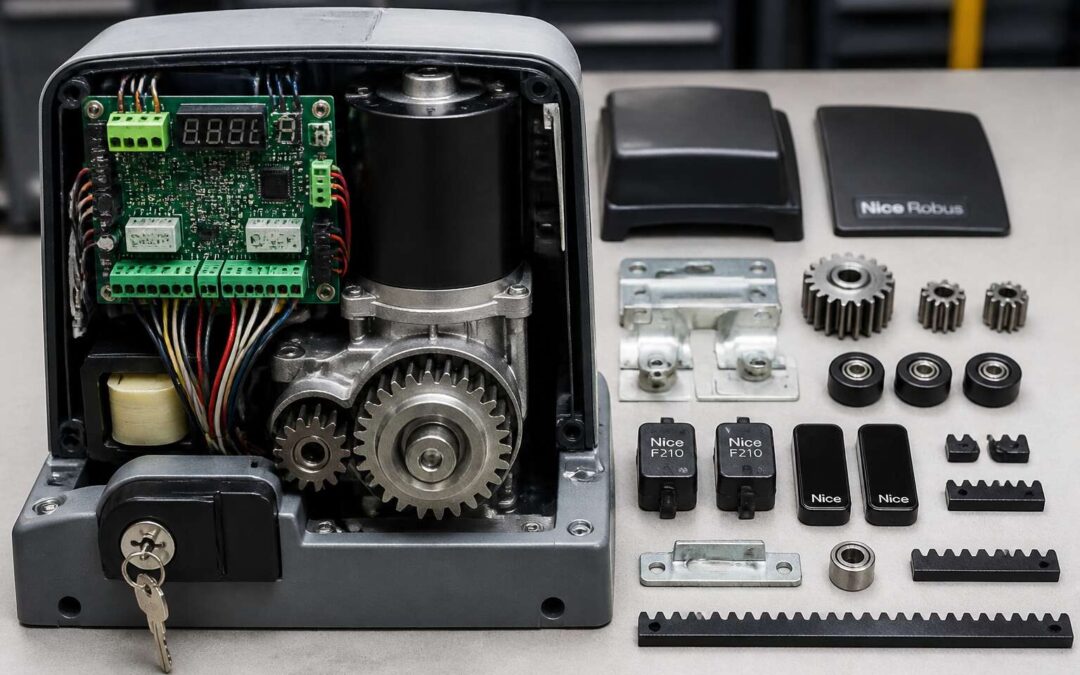
Understanding Sliding Gate Motor Spare Parts
Load shedding has a way of exposing weak points in home security. When your gate grinds to a halt halfway open, you feel it. The problem is often not the motor itself, but a single worn component inside it. South Africans face unique challenges here. Dust, humidity, and power surges take a toll on these machines. Understanding sliding gate motor spare parts is your first line of defence against costly replacements.
The cost difference between a small fix and a new unit is substantial. Most motors fail because of one specific part, not because the whole system is dead. Gears strip, capacitors blow, and limit switches drift out of alignment. Replacing these components is straightforward if you know what to look for.
Common parts that fail on a regular basis include:
– The gearbox and drive gears, which wear down from constant friction.
– The control board, often damaged by lightning strikes or load shedding surges.
– Limit switches, which fail after thousands of open and close cycles.
– The remote receiver, which can lose its pairing or simply die.
Sourcing quality parts locally matters more than you might think. Cheap imports can fit, but they often lack the hardening treatments of genuine components. That means faster wear and a return to square one in a few months. Pay attention to the brand and model number of your motor before ordering anything. A simple mismatch here can waste your weekend and your money.
Motor capacitors are another common culprit. They help the motor start and reverse direction. When a capacitor fails, you might hear a hum, but the gate stays put. The good news is that these are inexpensive and simple to replace. Just remember to discharge them safely before touching anything.
Suitability to our climate is worth considering too. Coastal areas in KwaZulu-Natal or the Western Cape bring salt air that corrodes metal parts faster. A regular maintenance schedule, paired with the right spare components, extends the life of your system considerably. Keep a few essentials on hand. It saves you from being locked out or locked in at the worst possible moment.
It is worth knowing that the motor unit and the gate itself work as a system. A stubborn gate puts immense strain on the motor. That strain shows up in the spare parts you end up buying. If your gate wheels are rusted or the track is bent, no amount of new parts will fix that.
Buying sliding gate motor spare parts before you need them is a practical move. It turns a potential crisis into a simple repair. Most homeowners who do this never look back.
Key Components and Their Functions
The first gentle nudge of your gate as it glides open is a small social courtesy. It tells visitors they are expected and the street that this household is attended to. Yet, this daily choreography relies entirely on the quiet diligence of a motor, and more specifically, on the condition of its internal organs.
Consider the gearbox. This is the strongman of the operation, tasked with converting the motor’s frantic spin into measured, powerful torque. When it wears down, you hear it as a grinding complaint. For those who prefer a preventative approach, the gearbox and its housing are essential sliding gate motor spare parts to keep in stock.
– Worn gears and pinions
– The drive sprocket
– Bearing assemblies
Then there is the circuit board, the social secretary of the entire system. It decides when to listen to your remote and when to ignore a stuck obstruction. A surge from Eskom’s grid is the ultimate party crasher here, often frying these delicate brains instantly. Keeping a spare board on hand is not paranoia; it is simple, practical home management. The motor itself may be the muscle, but the limit switches are the manners. They dictate exactly where the gate must stop, preventing it from slamming into the stopper with unseemly force. Acquiring the right replacement sliding gate motor spare parts ensures these polite cues are never lost.
How to Select the Correct Spare Parts
The wrong part will haunt you long after installation. I have seen gates groan, shudder, and refuse to move, all because someone chose a gear that did not match the motor’s teeth. When you search for sliding gate motor spare parts in South Africa, you are not buying mere metal and plastic. You are buying the difference between a gate that opens at dusk and one that traps you in the dark.
Consider the weight of your gate. Consider the frequency of use. Consider the voltage fluctuations that plague our grid. The part must endure all of it.
Here is what I check before any purchase:
– The model number etched on the motor housing
– The torque rating versus the gate’s actual mass
– The manufacturer’s approved supplier list
Listen, and the sliding gate motor spare parts you choose will serve you for years. Ignore the details, and you will face a long, silent evening at the boundary of your property.
Installation and Maintenance Best Practices
Nearly 40% of gate motor failures trace back to rushed installations. Installing sliding gate motor spare parts without a plan leads to crooked tracks and burnt out motors. Switch off the mains first. Then check the manual for torque settings. Many South African gate motors fail within a year because someone skipped this step.
Maintenance requires routine. Lubricate moving parts every three months. Inspect the gearbox for wear. Tighten bolts that vibrate loose. Replace any components showing rust immediately.
- Clean the tracks monthly
- Test the auto reverse function
- Check the battery voltage
These small actions save you from a gate that halts halfway during a thunderstorm. A little discipline beats an expensive callout every time.
Troubleshooting Common Problems
A gate that stops halfway feels like a personal insult. It is a mechanical failure with a psychological edge. I have seen this exact frustration play out on driveways across South Africa. The motor hums, the gate trembles, and then silence. Most people assume the whole system is dead. They are wrong. The problem often lives in a single component, waiting to be replaced.
The cause could be a stripped gear, a burnt capacitor, or a limit switch that lost its calibration. When you open the control box, look for signs of wear. Check the physical condition of the parts before touching any wiring.
- Inspect the gearbox for worn teeth or metal shavings
- Test the limit switches for consistent contact
- Listen for a clicking relay that never engages
Each of these failures points directly to specific sliding gate motor spare parts. Replacing the right component restores motion. That is the quiet triumph of troubleshooting. You are not fighting the machine. You are understanding its language.