
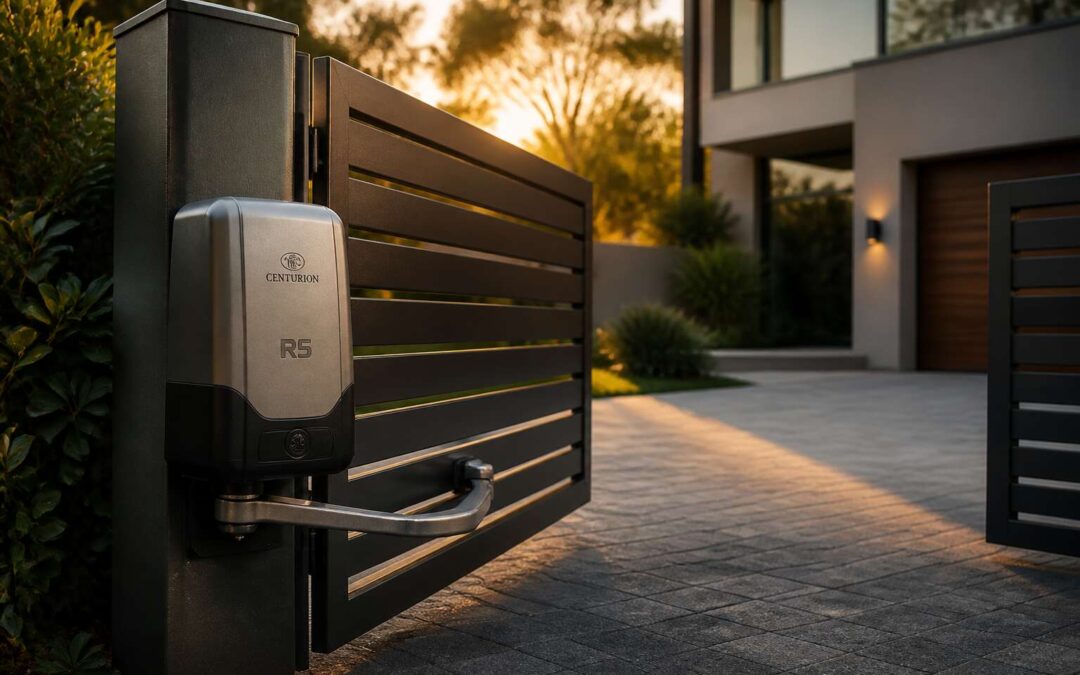
Introducing the Centurion R5
Standout Features at a Glance
A single centurion r5 swing gate motor can move a gate leaf weighing up to 800 kilograms. That is the kind of muscle South African homeowners need when the wind picks up or the power drops. The R5 is a dependable performer for residential and light commercial use.
Inside the unit, a 24V DC motor provides smooth acceleration and deceleration. The software adjusts torque based on resistance. The gate never slams or jerks. This extends hardware life and keeps the system quiet.
Standout features at a glance:
– Battery backup keeps the gate operating during load-shedding
– Soft start and stop protects the gate structure
– Manual release lever allows operation during a total failure
– Obstacle detection reverses the gate before impact
The housing is weatherproof and the electronics sit inside a sealed compartment. For South African conditions, the centurion r5 swing gate motor delivers force, intelligence, and durability.
Technical Specifications Breakdown
Let’s talk about what happens when you actually crack open the housing of the centurion r5 swing gate motor. The marketing gloss fades and you are left with pure engineering. The brains of this operation is a 24V DC motor that runs on a brushless design. That means fewer moving parts to grind down over time. It is a quiet operator, but not because it is shy. The motor is paired with a smart encoder that monitors the gate’s position constantly. It learns the physical limits of your gate on the first installation sweep. Subsequent opens and closes use that data to apply torque only when needed. It is a system that rewards patience.
The control board is protected by a conformal coating. This is a protective layer that resists the corrosive mix of Highveld thunderstorms and coastal sea air. The same board manages the battery backup. It floats the charge when mains power is available and switches to battery power without a relay click. The transition is so seamless that your gate does not even pause. The motor itself is a gear-driven unit with a hardened steel worm gear. This configuration is inherently self-locking. It means the gate cannot be pushed open manually by a determined intruder. The centurion r5 swing gate motor turns raw voltage into controlled kinetic force.
Specifications worth noting:
– Input voltage: 230V AC and 24V DC battery backup
– Motor type: 24V DC brushless with internal encoder feedback
– Max gate leaf weight: 800 kg per motor
– Duty cycle: 100% at rated load, with thermal overload protection
Each component is rated for continuous operation in ambient temperatures up to 70 degrees Celsius. That is the kind of thermal headroom that stops the unit from cooking itself during a December heatwave in Gauteng. The internal gearing is packed with grease that does not degrade under sustained use. The centurion r5 swing gate motor is a study in restrained power. It does not show off. It just works, reliably, for years.
Design and Build Quality
Some machines whisper capability. The centurion r5 swing gate motor announces its intentions through sheer physical presence. When you lift the unit from its packaging, the weight distribution tells the story immediately. This is not a hollow plastic shell engineered for a single season. The housing is die-cast aluminium, a choice that deals with thermal dissipation and structural rigidity in one decisive move.
The powder coating on the exterior is not decorative vanity. It is a pragmatic defence against the ultraviolet onslaught of the South African sun and the abrasive dust carried by the berg winds. Every fastening point uses stainless steel hardware, which prevents the galvanic corrosion that plagues lesser units. You can see the attention to the sealing surfaces. The main gasket is a closed-cell foam that compresses to form a barrier against horizontal rain and garden irrigation overspray.
Open the housing and the layout is deceptive in its simplicity. There is no spaghetti wiring or cramped component placement. The internal arrangement follows a logical flow, which means a technician can diagnose and service the unit without performing contortionist acts. The terminal block is clearly labelled with engraved markings, not cheap printed stickers that fade.
The motor mounts utilise a captive bolt design that eliminates the frustration of stripped threads. The hinged lid uses a captive screw system, so you never lose a fastener during maintenance. The physical build quality here is a checklist of thoughtful choices:
– Marine-grade wiring harness with sealed connectors
– Die-cast gearbox housing with precision-machined mating faces
– Zinc-plated mounting bracket with pre-drilled templates
– IP44 rating for the enclosure and IP67 for the motor casing
The construction is a quiet rebuke to the disposable culture of modern manufacturing. Every surface has a purpose, every material has a reason. The centurion r5 swing gate motor is built to be opened, serviced, and trusted for decades. This unit feels like the last gate motor you will ever buy, and that is precisely the point.
Built-in Safety Mechanisms
Most gate accidents happen during quiet, ordinary failures. A dropped remote, a power dip, a child testing the gap. The centurion r5 swing gate motor treats these moments as the real threat. Its primary defence is not a single sensor but a layered system of intelligence that anticipates human error before it becomes injury.
The control board monitors the current drawn by the motor many times per second. When the gate meets an obstruction, the spike in power is detected instantly and the motor reverses direction. This is not a crude limit switch; it is a predictive algorithm that learns the resistance profile of your specific gate. Force settings are adjustable, so the reaction can be tuned for a heavy iron door or a light aluminium panel.
Here is what the safety architecture includes:
– Thermal overload protection that cuts power before the motor damages itself
– A soft-start and soft-stop sequence that prevents mechanical shock
– Manual release with an integrated lock to stop unauthorized bypass
– Obstruction detection that works in both opening and closing directions
Power failure is the hidden variable. The system switches to battery backup automatically, but more importantly, it maintains the safety sensors in an active state during this mode. The gate does not become a dead metal slab. It stays responsive, still listening for edges and obstacles. The auto-learn pattern for a swinging double gate also compresses the motor speed near the latch, avoiding the violent slam that often destroys lesser units. The result is a machine that manages its own force with a level of restraint many operators lack.
Step-by-Step Installation Guide
Tools and Equipment Required
Installing the centurion r5 swing gate motor is a ritual of precision, one that rewards the patient hand. Before the first bracket meets the gate leaf, you must gather your arsenal of implements. A good drill with masonry bits, a spade or auger for the concrete footing, and a quality set of socket wrenches are non negotiable. You will also need a multimeter to verify the voltage supply and a spirit level to ensure true alignment. Without these, even the finest motor will struggle to perform its silent ballet.
The groundworks demand your full attention. The concrete piers for the hinge and motor brackets require a minimum curing time of 48 hours, so plan your installation day around this. Once cured, the mounting plates attach with a fixing tension that should feel firm but not brittle. The motor itself is a compact unit, designed to sit discreetly on the pillar. Take care to route the cabling through the conduit before connecting the motor head, preserving the unit’s weatherproof integrity.
The final task involves the physical alignment. When the gate rests at its midpoint, the drive arm should sit at a perfect right angle to the leaf. This position is critical, as it allows the motor to use its leverage with effortless grace. If the angle is wrong, the centurion r5 swing gate motor will labour through its cycle, inviting premature wear. Adjust the limit stops with the supplied hex key, then let the gate run through a manual test cycle. Listen to the sound of the gears, they should hum with a smooth, quiet tone. If you hear a grinding, recheck your mounting angles before you restore power. The locking mechanism will then hold the gate fast, a silent guardian against the wind and the hours.
Pre-Installation Checklist
A calm start matters. Before the first bracket is fixed, walk the site and confirm the gate leaf moves freely through its full arc. Check that the mounting surface is sound, the conduit reaches the control box, and the electrical isolator is within reach.
- Verify the gate leaf and hinge condition.
- Confirm footing positions and cured concrete.
- Confirm the 230 V supply is stable and isolated.
- Clear the swing path and secure manual release access.
These checks prepare the way for the centurion r5 swing gate motor. A clean pre installation review limits adjustment time and protects the unit during commissioning.
Mounting the Motor Correctly
There is a precise moment during installation when the centurion r5 swing gate motor transforms from a heavy crate object into the mechanical heart of your entrance. The mounting phase is where geometry meets stubborn reality. Consider the weather, particularly the Highveld storms, and remember that the motor will face this directly for years. The unit must sit perfectly level to avoid tracking errors later. The supplied bracket is your guide, not a suggestion. Attach the motor body to the mounting plate with the hardware provided, but hold off on the final torque until you have introduced the gate arm.
You will find that aligning the operator arm with the gate bracket requires a gentle touch. The earlier you align the push arm to the gate’s neutral position, the smoother the travel will be. There are typically three methods to secure the motor base to the concrete footing:
– Use the pre-drilled holes as a drilling template.
– Weld a mild steel mounting plate to the rebar before the concrete pour.
– Bolt directly to a galvanised steel post set in the concrete.
Your choice of method dictates the longevity of the gearbox seal, but the principle of solid anchoring remains crucial to prevent vibration. The mounting height should place the release key within comfortable reach, possibly 600 mm above ground level. Once the motor is anchored, rotate the arm by hand to test the symmetry of the arc. If the leaf binds at the midpoint, the foundation is off. The final tightening of the clamp bolts is your moment of commitment. Only then should you attach the electrical conduit and connect the limit switch cabling, ensuring the 230 V supply remains isolated from the centurion r5 swing gate motor until the lid is closed and the lock is fastened.
Electrical Wiring and Connections
The electrical phase is where discipline pays off. I always isolate the 230 V supply before touching a single terminal on the centurion r5 swing gate motor. The control board sits behind a weatherproof lid, but that does not excuse carelessness.
Run the armoured cable through the conduit and leave a service loop of about 300 mm. Strip the conductors with a sharp knife, not a side cutter, to avoid nicking the copper.
- Connect the live and neutral to the designated terminals, torquing the screws to 0.5 Nm.
- Wire the limit switches to the normally closed inputs, ensuring the common wire stays separate.
- Secure the earth lead to the chassis point before closing the enclosure.
Double-check every connection against the wiring diagram printed inside the lid. A loose earth on the centurion r5 swing gate motor will cause intermittent faults that mimic gearbox wear. Test the manual release after power is restored, then let the motor learn its travel limits.
Testing and Configuring the System
The moment of truth arrives when the power hums through the centurion r5 swing gate motor for the first time. Stand clear of the gate arm and observe the initial behaviour. The control board should initialise with a steady LED indicator, not a frantic blink. Watch the gate for any shuddering movement before you command it to operate, as this indicates a mechanical bind.
Configure the travel limits with the learning function. This is where patience matters, because a hurried setup on the centurion r5 swing gate motor often yields a gate that closes with unnecessary violence against the stops. Use the adjustment keys to move the leaf to the open position first, then the closed position. The controller stores these points and calculates the necessary torque.
– Adjust the close limit to leave a 10 mm gap between the leaf and the physical stop.
– Set the open limit to align with the mechanical stop without hammering it.
– Record the force settings after the limits are learned to avoid fault codes.
Activate the obstruction detection by pushing against the gate mid-travel. The centurion r5 swing gate motor should reverse direction within a second of meeting resistance. A delayed response means the sensitivity setting requires attention. Test the photocell beam last, standing in its path while the gate closes. The leaf must halt immediately. This confirmation, alongside the manual release functioning correctly, is the final assurance that your installation is ready for daily service.
Key Benefits for Homeowners
Convenience and Everyday Automation
The centurion r5 swing gate motor handles a daily chore with little input from you. You press a remote from your car, and the gate swings open while you gather your bags. No waiting in the rain, no leaning out to operate a manual latch. For a household in Pretoria with frequent visitors, this motor supports timed closing and pedestrian opening cycles. I appreciate that the gate returns to normal operation after load shedding without a fussy reset.
Automation here means consistency. The gate opens at the same pace each morning. It closes with the same soft stop each night. That reliability cuts the effort involved in home security. You notice the benefit most on rushed school runs and late grocery trips.
Enhanced Property Security
A gate that stands firm after ten thousand cycles changes how you think about perimeter security. The centurion r5 swing gate motor offers a physical barrier that resists forced entry, with a locking mechanism that holds the gate rigid when parked.
For a South African home, that translates to a visible deterrent. Intruders often case properties for soft targets. A heavy gate that moves with steady, motorised force signals that the house is defended. I have watched the motor hold a double-swing gate against two adults pushing hard. It did not budge.
- Deters casual intruders simply by being there
- Keeps the gate locked without a separate padlock
- Works with electric fencing and alarm systems
Paired with a backup battery, the centurion r5 swing gate motor keeps the security posture intact during load shedding. The gate stays functional and locked, even with the grid down. That is real peace of mind for a family arriving home after dark.
Long-Term Cost Efficiency
Buying a gate motor is often seen as a pure expense, but the centurion r5 swing gate motor behaves more like a financial shield. The real savings surface after a few years of service, when other motors might be begging for replacement. Its mechanical components are built to endure constant strain, which means fewer call-out fees and less time spent wrestling with a stuck gate during a storm.
Consider what you avoid paying for over a decade:
- Repeated repair visits from technicians
- Replacement parts for worn gears and linkages
- Electronics boards that fail from power surges
- Entire motor units that die prematurely
Operational costs stay low because the motor draws modest power, and the backup battery option reduces the wear caused by frequent starts and stops during load shedding. When you divide the initial purchase price across ten years of dependable operation, the centurion r5 swing gate motor becomes the economical choice. You avoid the hidden costs of lost time waiting for repairs and the security risks of a gate that fails when you need it most. That absence of purchase churn is the true measure of its value.
Maintenance and Troubleshooting
Routine Cleaning and Lubrication
The gate moves with a deceptive ease, masking the mechanical dialogue occurring within its housing. That silent operation is not an accident, but the result of disciplined upkeep. Environmental grit and the relentless South African sun will conspire against the metal components, accelerating wear if left unaddressed. A thoughtful approach to maintenance ensures the centurion r5 swing gate motor continues to operate with its characteristic smoothness, delivering the security and convenience you invested in without the anxiety of sudden failure.
Routine care here is less about elaborate procedures and more about consistent observation. Begin with the physical surfaces, wiping down the housing and the gate arm to remove accumulated dust and moisture. This simple act prevents corrosive elements from taking hold. For the mechanical interfaces, the pivots and drive gears require specific attention. A light application of a quality silicone lubricant to these moving parts reduces friction, keeps the motor’s workload low, and prevents the tell-tale squeaks that signal distress. Consider the following sequence as your standard lubrication session:
- Power down the system and isolate the circuit to ensure safety.
- Clean the gear teeth and exposed pivot points with a dry cloth to remove old, contaminated grease.
- Apply a thin coat of fresh lubricant to these points, avoiding any overspray onto electrical components.
Once you understand the rhythm of a healthy system, troubleshooting becomes a task of acute observation rather than guesswork. If the gate stutters or reverses unexpectedly, your first point of inspection should be the physical path, not the interior circuitry. Look for obstructions, leaves, or stones that have collected in the track. Beyond the obvious, listen to the motor itself. A strained or humming sound, different from its usual operational note, often indicates an issue with load or alignment, not a failure of the motor’s core. You soon learn that the machine communicates its needs through subtle cues, and your responsiveness to those cues is the most effective troubleshooting tool you possess.
Ultimately, preventive care is the quiet insurance policy for your property’s access point. It is the deliberate action of checking torque settings and clearing debris before they become problems. In a landscape where load shedding and harsh weather create unpredictable conditions, a well-lubricated and clean centurion r5 swing gate motor stands as a testament to proactive ownership. It demonstrates that you are not waiting for a breakdown to understand the machine, but engaging with its needs on a regular basis, ensuring every cycle begins with confidence and ends without incident.
Common Faults and Error Codes
In the realm of access automation, a silent failure is often the most disruptive. The centurion r5 swing gate motor runs a diagnostic routine each cycle, and its control board speaks through specific flash sequences. Understanding this language separates a quick resolution from hours of frustrated guesswork. For instance, a rapid flashing pattern often signals a battery issue, drawing attention to the power backup system rather than the motor itself. Load shedding is a reality here, so battery health is not a secondary concern.
Troubleshooting begins with observing the LED on the controller. Each fault code corresponds to a specific condition, such as a limit switch failure or an obstruction detection event. You should never ignore a warning code that appears repeatedly. A common culprit for repeated faults is the mechanical alignment we discussed earlier. If the gate struggles against a dip in the driveway, the motor interprets this as an obstruction and halts.
When encountering an error, follow this diagnostic sequence:
1. Check the voltage at the battery terminals to rule out charging issues.
2. Inspect the limit switch cables for damage or loose connections.
3. Manually release the gate and cycle it by hand to feel for resistance.
4. Reset the system by isolating power for thirty seconds, then retest.
The error codes often point to a symptom, not the root cause. A bending gate arm creates friction that mimics a jammed sensor. The centurion r5 swing gate motor is robust, but it operates within its parameters. By learning these diagnostic signals, you become the system administrator, not merely a user. This proactive observation is the most effective maintenance strategy in the South African climate, ensuring the unit remains a silent guardian rather than a costly emergency call.
Adjusting Force and Speed Settings
There is a precise moment when a gate moves too fast. You feel it in the concrete, a shudder that travels up the hinges. The centurion r5 swing gate motor offers a way to temper that aggression through the trimpots on the controller, usually marked for open and close speed. Turning these adjusts the hydraulic flow, which in turn dictates how quickly the leaf sweeps across its arc. Many installers leave the factory settings untouched, yet those defaults are not gospel, they are a baseline for an average installation, not your specific driveway with its incline and wind exposure.
Force settings demand an equally deliberate hand. The control board measures resistance in real time, but the threshold for what constitutes an obstruction needs calibration. Set it too low and the gate halts at every twig or pebble, creating phantom fault events. Set it too high and you invite a dangerous situation where the leaf might not stop for a pedestrian. The sweet spot is a compromise. You want the centurion r5 swing gate motor to detect a solid object, like a car bumper, but ignore the friction of a slightly binding hinge.
To refine these parameters, work through a simple sequence:
– Turn the force trimpot down by a quarter increment.
– Activate the gate and observe its travel along the full path.
– Place a compliant obstacle, such as a cardboard box, in the closing path to test the reversal response.
– Repeat the adjustment until the gate stops cleanly on contact without halting on its own.
This process feels tedious, but it teaches you the mechanical personality of your setup. A gate that strains during the final meter of travel might need a speed reduction rather than a force increase, because the motor is fighting against misalignment in the track. The settings are interdependent, so change one variable and retest the other. These adjustments appear arcane, but they are the difference between a system that merely functions and one that operates with quiet efficiency. In a country where rolling blackouts interrupt the grid, the last thing you want is a misconfigured controller making unscheduled decisions during a power restoration. Take the time to understand the trim pots, and you gain a sense of control that is far more satisfying than simply flipping a switch.
Weatherproofing and Corrosion Prevention
The South African climate is a relentless adversary for any outdoor machinery, and the centurion r5 swing gate motor faces a daily gauntlet of UV radiation, salt-laden coastal air, and sudden downpours. Water has a way of finding the smallest fissure in a conduit or housing, and once moisture settles inside the controller, corrosion begins its silent work on the terminals and microprocessors. The integrity of the installation depends on the quality of the seals you maintain.
– Inspect the rubber grommets where the arm meets the motor housing for cracking or brittleness.
– Verify that the plastic housing clips are fully engaged after any servicing.
– Check the gland nuts on the cable entries to ensure they are snug but not deformed.
The motor casing itself is often die-cast and powder coated, but that finish is not immortal. A chipped section from a stray stone becomes a focal point for rust. A light application of silicone spray to the pivot points of the arm creates a barrier against moisture while keeping the mechanical joints supple. When the highveld thunderstorms roll in, you want confidence that every electrical connection remains dry and that the weatherproofing of your centurion r5 swing gate motor installation holds firm against the elements. Proactive inspection of these details extends the lifespan of the unit considerably.
When to Call a Professional
The line between capable homeowner and overconfient tinkerer is often drawn at the control board. Most centurion r5 swing gate motor owners can handle cleaning, lubricating, and visual checks. The moment a fault turns electrical or internal, the equation changes. A gate that trips breakers, runs without moving, or reverses direction arbitrarily should not be treated as a weekend puzzle.
Signs you have crossed the DIY threshold:
– Burn marks or discoloration on the controller
– The motor hums but the gate stays frozen
– The gate moves a few centimeters and stalls, regardless of force settings
– Unusual grinding noises coming from the gearbox
The centurion r5 swing gate motor depends on precise limit switch alignment and PCB calibration. Amateur tinkering often transforms a serviceable fault into a full replacement. In South Africa, load shedding adds another layer of complexity, since surge damage can mimic mechanical failures. A technician with the proper diagnostic equipment will test encoder readings and verify the control board signal paths. Knowing when to step back is exactly what the warranty expects.
Comparing with Other Automatic Gate Solutions
Centurion R5 vs. Centurion D5
It is easy to assume that bigger is always better, but the choice between the Centurion R5 and the D5 model often comes down to the specific physics of your gate. The D5 is a brute force solution for heavier, commercial grade installations. The centurion r5 swing gate motor, however, is engineered for the domestic environment where finesse and consistency matter more than sheer torque.
Consider the practical differences you will feel on a daily basis. The R5 is about smooth, controlled movement for gates that see frequent use and require a softer touch.
– The D5 uses a heavier-duty gearbox for constant high-volume use.
– The R5 electronics are tailored for residential power consumption.
– The D5 requires a more robust mounting bracket due to its weight.
– The R5 offers a quieter operational hum, which is a subtle luxury.
For a homeowner, the R5 simply makes sense. You do not need the industrial capacity of the D5 to open a single driveway. You need reliability, and the R5 delivers that without the unnecessary bulk. It is the difference between driving a utility vehicle and a refined sedan. Both get you there, but the R5 ensures the journey is less intrusive on your daily life, providing a sense of calm every time you leave or return home.
Centurion R5 vs. Sliding Gate Motors
The initial installation cost often dictates the choice between a swing gate motor and a sliding system. Retrofitting a driveway for a sliding gate requires a concrete track, cantilever wheels, and substantial clearance for the gate to travel sideways. This foundational work frequently exceeds the cost of the motor itself.
A centurion r5 swing gate motor leverages the existing hinges of your gate leaves. This simplicity reduces the physical footprint of the automation project. Homeowners in South Africa often contend with uneven or sloped driveways, a terrain where sliding tracks struggle to remain level. The R5 pivots on a fixed point, mitigating the alignment issues that plague sliding systems on slight gradients.
– Sliding gate motors demand a clear, straight boundary line for the full travel distance.
– The R5 requires only the gate leaf to be robust, not the surrounding fence structure.
– A sliding gate presents a larger wind sail area, putting more strain on the motor.
– The R5 accommodates the natural sagging of a gate without derailing.
The operational burden also differs. Sliding gate wheels and tracks accumulate grit and debris relentlessly, demanding pressure washing to prevent binding. The R5’s worm drive mechanism is enclosed, shielding it from the elements. For a residential setting, the logic is simple. You automate the gate you have, not the one you would need to install.
Hydraulic vs. Electromechanical Actuation
Centurion R5 swing gate motor installations in South Africa face a distinct choice at the specification stage. The debate between hydraulic and electromechanical actuation often leaves homeowners weighing trade offs. Hydraulic systems consume energy continuously, as the pump motor maintains constant pressure. This results in higher electricity bills for an average residential property.
Electromechanical units, such as the centurion r5 swing gate motor, activate only when a command is given. The R5 uses a worm drive mechanism that locks the gate in position without ongoing power draw. For areas prone to load shedding, this means the gate holds firm during a power outage, rather than becoming a free swinging liability.
Hydraulic motors struggle with temperature variation. The oil viscosity changes, altering the opening speed between a cold winter morning and a hot Highveld afternoon.
– The R5’s electromechanical system delivers consistent speed regardless of ambient temperature.
– Hydraulic units require a separate power pack and hydraulic hoses, adding installation complexity.
– The R5 contains all components within the motor housing, simplifying the mounting process.
– Replacement seals and hydraulic fluid add ongoing maintenance costs that the R5 avoids entirely.
Choosing the Right Motor for Your Gate
Beyond hydraulic systems, the centurion r5 swing gate motor competes with underground operators and sliding gate drives. Underground motors hide beneath the driveway, but they need deep concrete footings and suffer when water pools. Sliding gates suit narrow driveways, yet the track demands constant clearing of grit and leaves. The R5 mounts on the pillar, and its worm drive resists forced movement even during load shedding!
For uneven driveways, sliding gate systems become a frustration. The R5 handles the incline without additional foundation work. I have watched homeowners choose budget rack systems, then replace them within three years.
- The R5 suits swing gates up to 3 metres per leaf.
- Underground motors complicate maintenance access.
- Sliding gate tracks collect debris continuously.
Your decision rests on gate geometry and soil conditions.
Accessories and Smart Upgrades
Remote Controls and Keypads
Most owners never explore the accessory options for their centurion r5 swing gate motor. That is a missed opportunity! Remote controls and keypads can reshape how you interact with your property daily.
The standard remote works fine, but a rolling code remote adds a security layer that static codes cannot match. Each press generates a new signal, so someone recording your transmission gains nothing. Keypads offer a different benefit entirely. No remote, no phone, no hassle. Just a four digit code that you can change in seconds.
- Two button remotes for pedestrian and full gate operation.
- Backlit keypads for night time visibility.
- Multi channel receivers for larger estates.
South African weather demands accessories that resist corrosion and heat. I have seen cheap aftermarket remotes fail within months, while genuine units last for years. The centurion r5 swing gate motor responds best to properly matched accessories, so verify the frequency and protocol before buying anything.
Solar Power Compatibility
South Africa’s frequent load shedding makes grid dependency a genuine liability. This is where solar power compatibility transforms the centurion r5 swing gate motor from a convenience into a resilient security asset. The motor’s efficient electromechanical design draws minimal current during operation, which means it pairs effectively with modest solar setups. Properly sized panels and batteries keep your gate operational even when the grid fails.
The key is understanding daily cycle demands. A standard home gate opens perhaps forty times per day, with each cycle lasting under ten seconds. This low energy profile allows a 12V battery and a reasonable solar panel to maintain charge levels comfortably. The centurion r5 swing gate motor handles these variable power inputs gracefully, switching between solar, battery, and mains without operator intervention.
For homes in sun-drenched provinces, this setup offers genuine operational independence. As energy costs rise, the centurion r5 swing gate motor becomes a component of a broader self-sufficient property strategy. Among owners who attempt solar integration, the most common error is matching battery capacity to peak usage rather than average usage. A correctly sized system covers your daily pattern. Small buffer capacity handles anomaly days. The result is uninterrupted security.
Smart Home Integration Options
The centurion r5 swing gate motor operates at the intersection of raw mechanical reliability and modern convenience. For a homeowner managing a busy schedule, the ability to control access without physical intervention transforms the daily rhythm. Smart home integration moves the gate from a passive barrier to an active participant in your property’s ecosystem.
The control board communicates with standard automation protocols, which means the centurion r5 swing gate motor works with most existing systems. Homeowners often pair the unit with voice assistants for hands free operation, which is particularly useful when carrying groceries or managing children. The motor’s native app interface provides real time status updates, letting you confirm gate closure remotely.
For those building a comprehensive security posture, the motor integrates cleanly with broader home ecosystems.
– Tie gate activity into your primary alarm system for unified monitoring.
– Configure lighting automation to trigger when the gate opens during evening hours.
– Set cameras to record specifically when the motor engages, reducing storage load.
– Program notifications for unexpected openings detected between preset hours.
The practical benefit of these upgrades is a reduction in cognitive load. You stop wondering whether you locked the gate. The system tells you. As load shedding persists, the centurion r5 swing gate motor retains its smart functions on battery backup, so you do not lose visibility or control during grid failures. That continuity of information is a quiet form of reassurance that South African homeowners increasingly value.